Nomad Sculpt
- 3.6
- Rating
- 1.00M
- Installs
- Free
- Price

 Analysis by App-foxy
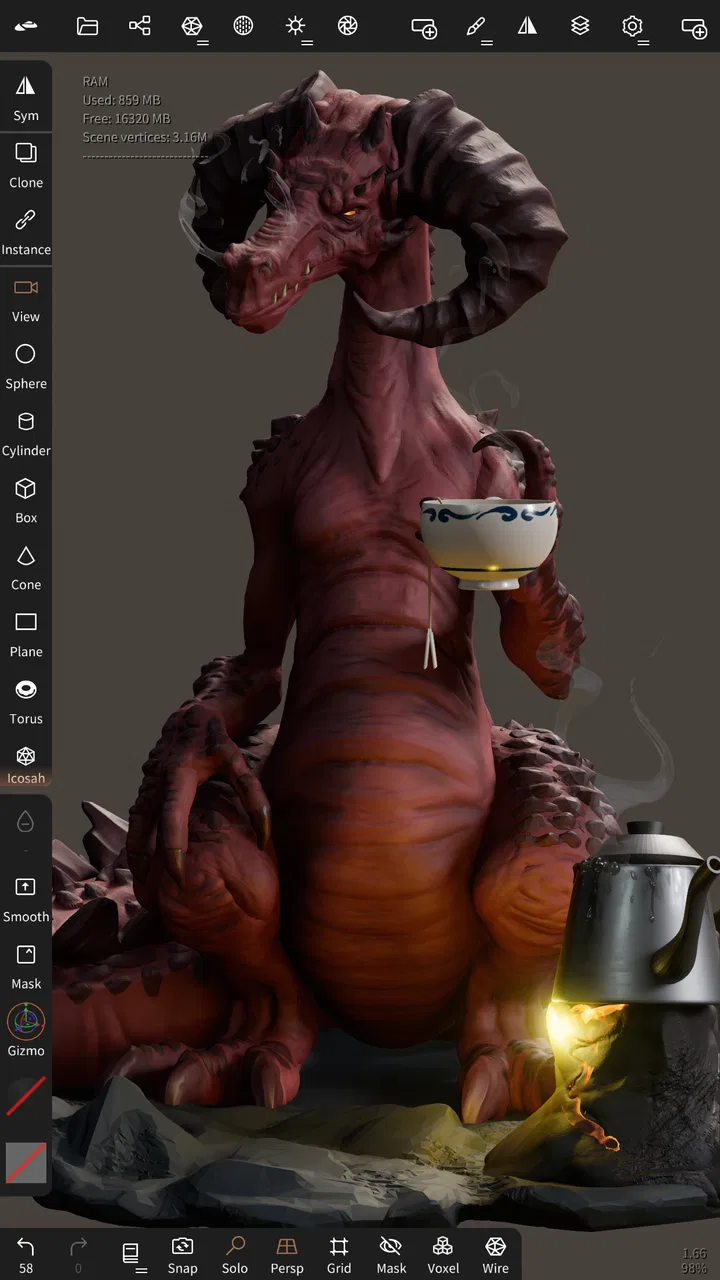
I approached Nomad Sculpt as a mobile art tool rather than a miniature version of a desktop workstation. That distinction matters. The app is built for sculpting, painting, and creating in 3D, but its real appeal is the freedom to work directly on a phone or tablet when opening a full computer setup would be inconvenient. I found it most interesting as a practical sketchbook for form: something I could use to block out a character, test a creature design, or explore a product shape without waiting for a desk, a mouse, and a larger program.
It comes from Hexanomad and sits in the Art & Design category. The app is free to download, aimed at Everyone, and supports devices running Android 8.0 or later. That broad compatibility helps explain why it has reached more than a million installs, although its average rating of 3.5 from roughly 8.3 thousand ratings suggests that the experience depends heavily on the device, the user’s expectations, and how comfortable they are with a touch-based 3D workflow.
How Nomad Sculpt feels during real creative work
I find the best way to judge Nomad Sculpt is to treat it as a place for deliberate, small creative decisions, not as a shortcut to a finished model. That framing also makes it easier to notice where trust matters: what I can see and control while working, and what I should avoid assuming about data or permissions. From there, I can look at the moments when a project becomes personal and decide how much care to take before sharing or continuing it.
You May Also Like

 Blood Strike: 2.5 Anniversary
Blood Strike’s Loadouts Turn Every Drop Into a Tactical Gamble
A close look at Blood Strike’s custom loadouts: how fast access to signature weapons reshapes its battle royale rhythm, rewards preparation, and narrows the gap between fights.

 Pandora - Music & Podcasts
Pandora’s Music Is Easy to Start, but Harder to Recover
Pandora’s strength is its low-effort path from a seed to a station. Its weak spot is how much confidence it asks you to place in connection, setup, and quiet recovery.

 8 Ball Pool
 Is Built on Rivalries, Rematches, and Routine
A close look at the rivalries, rematches, shared routines, and unanswered safety questions that turn a quick pool match into a persistent mobile community.

 Samsung Music
’s Quiet Strength Is Playing What You Already Own
Its reach comes less from spectacle than from dependable access to a personal library. That simplicity is both the app’s strongest retention engine and its ceiling.

 AccuWeather: Weather Radar
AccuWeather Review: A Quick, Clear Forecast for Everyday Decisions
For everyday plans, the best forecast is the one you can understand quickly. AccuWeather makes rain timing, radar, and local conditions easy to act on, with a few trade-offs.

 Hill Climb Racing
Why Hill Climb Racing Still Turns Crashes Into One More Run
A tiny car, a bumpy hill and one more upgrade: Hill Climb Racing keeps resurfacing because its simple chaos makes every near-miss feel personal.
More From Our News Desk



A quick start, but not an instant learning curve
The first useful thing to understand is that Nomad Sculpt is not a simple drawing app with a few 3D effects added on top. It asks me to think in terms of volume, surfaces, camera position, and repeated adjustments. I can begin with a basic form and gradually push it toward a face, an animal, a prop, or an abstract object, but the quality of the result depends on learning how the sculpting tools behave.
For a quick idea, the app feels reasonably direct. Touch input makes it easy to rotate around a model, zoom in on a detail, and make broad changes without a complicated setup. I especially like that this encourages a different kind of creativity from flat sketching. Instead of deciding how a single view should look, I can check whether the shape works from several angles. That is valuable when I am designing a toy, a mascot, a simple game asset, or a reference model for later work.
The speed I perceive depends less on the opening screen and more on the size and complexity of the scene I am building. A small blockout should feel much more approachable than a detailed model with many refined areas. This is a normal trade-off for mobile 3D, but it is worth keeping in mind before treating a phone as a complete replacement for a desktop sculpting setup. The best mobile workflow is to begin with simple forms and add detail only when the shape is already working.
I would not recommend starting with tiny surface details. On a touchscreen, it is easy to spend time polishing an area that later needs to be reshaped. My preferred order is broad silhouette first, secondary forms next, and fine work only after rotating the model repeatedly. That habit makes the app feel faster because it reduces unnecessary corrections, not because the device is doing less work by magic.
Where the app becomes demanding
Heavy use arrives when I combine a dense sculpt with repeated brushes, close camera work, and several layers of refinement. A large model can become harder to manage on a small screen simply because the interface and the artwork compete for space. Even when the app remains usable, my own precision drops when I am trying to make a delicate adjustment with a finger on a compact display.
A tablet is therefore a much better fit for serious sessions than a small phone. The larger canvas gives me more room to inspect contours and keep controls away from the area I am editing. A phone still makes sense for rough exploration, quick corrections, or a short creative break, but I would not choose it as my main environment for detailed character work unless I already knew the touch controls well.
One practical workflow is to use the phone for shape exploration and reserve the tablet for refinement. I can decide whether an idea has potential while travelling, then continue with more comfortable framing later. That approach also limits the risk of spending a long session on a device that becomes uncomfortable because of heat, battery use, or cramped controls. The app is flexible enough to support that kind of mobile-first process, but the user has to set sensible boundaries.
The current version is 2.8, and the app’s feature set is broad enough that I would expect some experimentation before finding an efficient arrangement of tools. I do not see that as a flaw by itself. It is the price of having a serious sculpting environment in a mobile format. The friction appears when I want an immediate result without learning how the different operations affect the model.
Stability and recovery deserve attention
For me, reliability in a 3D app is not only about whether it opens. It is also about whether I can work confidently, undo a poor decision, and avoid losing a useful stage of a model. I make a habit of saving at meaningful milestones rather than waiting until the end of a long session. That is good practice in any creative application, but it matters even more on a mobile device that may be interrupted by a call, a low battery, or another app.
I would treat recovery as part of the workflow rather than an emergency plan. Before a major structural change, I prefer keeping a clear earlier stage available. This is particularly useful when experimenting with proportions: a dramatic adjustment may look promising from one angle and wrong from another, and returning to a previous state is much easier than trying to reconstruct the original form manually.
Users who expect every session to feel as predictable as a mature desktop production tool may find mobile interruptions frustrating. The app is better suited to deliberate, saved stages than to careless marathon sessions where everything depends on one continuously open scene. I also recommend checking the model from different views before committing to a long detail pass. That simple check prevents a lot of recovery work later.
What the device changes
Nomad Sculpt can run on older supported Android devices because the minimum operating-system requirement is Android 8.0, but that does not mean every compatible device will feel equally comfortable with demanding scenes. The operating system requirement tells me whether installation is possible; it does not guarantee the same display size, memory headroom, touch response, or sustained performance across phones and tablets.
On a modest phone, I would keep projects relatively focused and avoid treating the app like an unlimited digital clay studio. A newer or larger device should provide a more pleasant experience, especially when the model needs close inspection. I would also avoid beginning an important commission or study on a device I have never tested with a similar scene. A short trial with a simple model can reveal whether the screen, controls, and sustained workload suit me.
There is another constraint that is easy to overlook: ergonomics. Sculpting on glass for a few minutes is different from sculpting for a full evening. My hand position, the size of the model on screen, and the need to alternate between navigation and editing all affect precision. A stylus-compatible tablet may be preferable for users who already work that way, while someone who enjoys direct finger gestures may find a phone more spontaneous.
This is where Nomad Sculpt differs from many conventional drawing alternatives. A two-dimensional sketch app is usually faster for thumbnails, notes, and visual planning. A desktop 3D package is generally better for long production sessions, extensive asset management, or workflows that depend on a keyboard and large monitor. Nomad occupies the middle ground: more spatially useful than a drawing app, more portable than desktop software, and less comfortable for complex work than a full workstation.
Useful workflows beyond the obvious sculpt
The most valuable use case I found is early design exploration. Suppose I am planning a small creature for an illustration. I can block out the body, rotate it to check the silhouette, and use that model as a reference while drawing the final image. This helps me catch proportion problems that are easy to miss in a single sketch. I do not need the model to be production-ready for it to save time.
A second use is communicating an idea to someone else. A rough 3D shape can explain the relationship between parts more clearly than several flat drawings. For a handmade object, a prop, or a simple character, being able to turn the form around gives a collaborator a better sense of the design. The app becomes a visual conversation tool, not just a place to make a finished asset.
A third, less obvious advantage is learning observation. When I sculpt a face or an animal, I have to notice how planes change across the form. Rotating the model exposes weak areas that a front-facing drawing can hide. I find this useful for improving my understanding of volume, even when the final result will never leave the app. It turns practice into something more active than copying a reference on a flat surface.
I also recommend a low-detail “thumbnail scene” approach. Instead of creating one ambitious model, I can make several rough variations with different proportions. This is a better use of mobile time than trying to finish the first idea immediately. The trade-off is that each variation still requires navigation and cleanup, so the method works best when the goal is comparison rather than presentation.
Where it may not be the right choice
I would skip Nomad Sculpt if my main need is traditional illustration, photo editing, layout design, or quick social media graphics. A dedicated two-dimensional app will usually get me to those results faster and with less mental overhead. The 3D environment only earns its place when depth and rotation are genuinely useful to the project.
I would also hesitate to make it the only tool for a long professional pipeline that involves many dependent stages. A desktop application may be preferable when I need a large monitor, extensive keyboard shortcuts, predictable file organization, or a broader production environment. Nomad is strongest when portability and direct manipulation matter more than having every surrounding workflow in one place.
Beginners should not confuse “free” with “effortless.” The app costs nothing to download, but learning sculpting still takes patience. There are in-app purchases priced at $19.99 per item, so I would explore the free experience carefully and decide whether the extra spending fits my needs before building a workflow around paid additions. The sensible approach is to learn the core interaction first, then pay only when a specific need becomes clear.
The Everyone content rating makes it approachable from an audience standpoint, but the creative depth means younger or completely new users may still benefit from guidance. The challenge is not inappropriate material; it is understanding how to build forms without becoming lost in detail. A short, goal-based exercise is more useful than opening the app and trying to master every tool at once.
My performance verdict after using it as a mobile studio
Nomad Sculpt succeeds because it makes 3D form exploration feel possible away from a traditional computer. I value it most for blockouts, visual studies, reference models, and ideas that need to be checked from every direction. Its touch-first nature can be liberating, especially on a tablet, and the free entry point makes it easy to discover whether this kind of creation suits me.
Its limitations are equally clear. Detailed work can become demanding, small screens reduce precision, and serious users need a disciplined approach to saving and managing creative stages. The app cannot remove the physical limits of mobile hardware or replace the comfort of a full desktop setup for every task. I also would not judge it solely by how quickly a first model appears; the real test is whether the workflow remains comfortable as the object becomes more complex.
Hexanomad has made a focused tool rather than a generic art app, and that focus is its main strength. If I wanted a portable way to think in three dimensions, I would recommend giving it a fair trial on the largest compatible device available to me. If my priority were fast flat illustration or a complete desktop production pipeline, I would choose something else. For the right user, though, Nomad Sculpt is a practical bridge between a quick sketch and a fully developed 3D workflow, provided I respect the device’s limits and learn to work in stages.
FAQs for Nomad Sculpt
01What is Nomad Sculpt and what can I create with it?
Nomad Sculpt is a 3D sculpting app designed for mobile devices. It's ideal for artists who want to create detailed 3D models on the go. With an intuitive interface, you can sculpt, paint, and texture models with ease. It's perfect for creating characters, objects, and intricate designs, making it a favorite among digital artists.
02Is Nomad Sculpt user-friendly for beginners?
Yes, Nomad Sculpt is designed with beginners in mind, offering an intuitive and straightforward interface. It provides a range of tutorials and guides to help new users get started. The app’s tools are easy to learn, allowing budding artists to quickly grasp the basics of 3D sculpting and gradually explore more advanced features.
03Does Nomad Sculpt support stylus input for precision work?
Absolutely, Nomad Sculpt fully supports stylus input, enhancing precision in your sculpting projects. This feature is particularly beneficial for detailed work, allowing for precise control over brush strokes and other tools. It's compatible with popular styluses, making it a versatile choice for artists who prefer using a pen over finger touch.
04Can I export my creations from Nomad Sculpt to other platforms?
Yes, Nomad Sculpt offers multiple export options, allowing you to save your creations in various formats such as OBJ, STL, and GLB. This flexibility makes it easy to transfer your models to other 3D software for further refinement or for use in other projects, including game development or 3D printing.
05What are the system requirements for running Nomad Sculpt smoothly?
Nomad Sculpt is optimized for both Android and iOS devices, but to run it smoothly, a device with a decent processor and sufficient RAM is recommended. While it can run on most modern smartphones and tablets, having a device with higher specifications will ensure better performance, especially when working with complex models.
Pros
- Intuitive user interface for easy navigation.
- Highly responsive sculpting tools.
- Supports multi-resolution sculpting.
- Regular updates with new features.
- Compatible with Apple Pencil and styluses.
Cons
- Requires significant storage space.
- Steeper learning curve for beginners.
- Limited free version features.
- Occasional performance lags on older devices.
- No direct export to all 3D file formats.

Nomad Sculpt
Gallery